
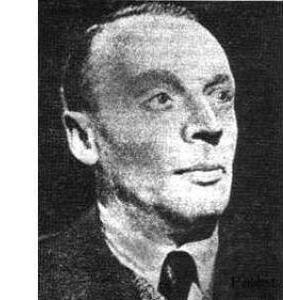
Mikola Kulikovich
Mikalai Shchahlou-Kulikovich
1893(?)–1969. Belarusian composer, musicologist, historian of Belarusian music, ethnographer, conductor, poet, and figure of the Belarusian movement in emigration.
4 April 1893, Moscow (or 13 October 1896, or 4 November 1897; the exact date and place differ across sources).
Born in the Belarusian part of the Smolensk region into an Orthodox Russian-Belarusian family. Orphaned early, he was raised by his aunt, an abbess of an Orthodox convent in Tver. There he began to sing in the convent choir and quickly drew the attention of teachers at the Moscow Synodal School of Church Music.
Graduated from the Moscow Synodal School of Church Singing. Studied under the renowned composer A. Kastalsky. As an alto soloist he toured Europe.
By 1925
Attended and graduated from the Moscow Conservatory.
1928
Birth of his daughter Natalla (from his first marriage to Natalla Chamiarysava. He was married twice. His second wife was the singer Nadzeya Hrade-Kulikovich, who after his death transferred the composer’s archive to the Francis Skaryna Belarusian Library in London).
1930s
Engaged in collecting and studying folklore in the Smolensk region. For a time he lived in Ukraine.
1936
Moved to Minsk. Worked as a music teacher and music editor at Belarusian Radio. He became one of the founders of the Opera Theatre.
1937
Became conductor of the symphony orchestra of the Belarusian Radio Committee.
Late 1930s
Actively involved in the founding of the Belarusian Opera and Ballet Theatre, where he worked as conductor of its symphony orchestra. Contributed to the journal Sovetskaya Muzyka.
1940
For the decade of Belarusian art in Moscow, he wrote the cantata Stalin, and was by then an established composer.
1941–1942
Remained in occupied Minsk. Continued to collect Belarusian musical folklore.
1942
Prepared the study The Belarusian Song (manuscript). Composed the opera Forest Lake to a libretto by N. Arseńnieva. After the restoration of the Belarusian Autocephalous Orthodox Church, he worked on reforming church music. He headed the music sections of the Belarusian Cultural Council and the Belarusian Cultural Union.
1943
Published in Minsk a Collection of Kupala and Harvest Belarusian Songs. He published articles in the Belarusian Newspaper and the journal New Path.
1944
Headed the music department of the Belarusian Cultural Union (set up by Nazi Germany in the occupied territory).
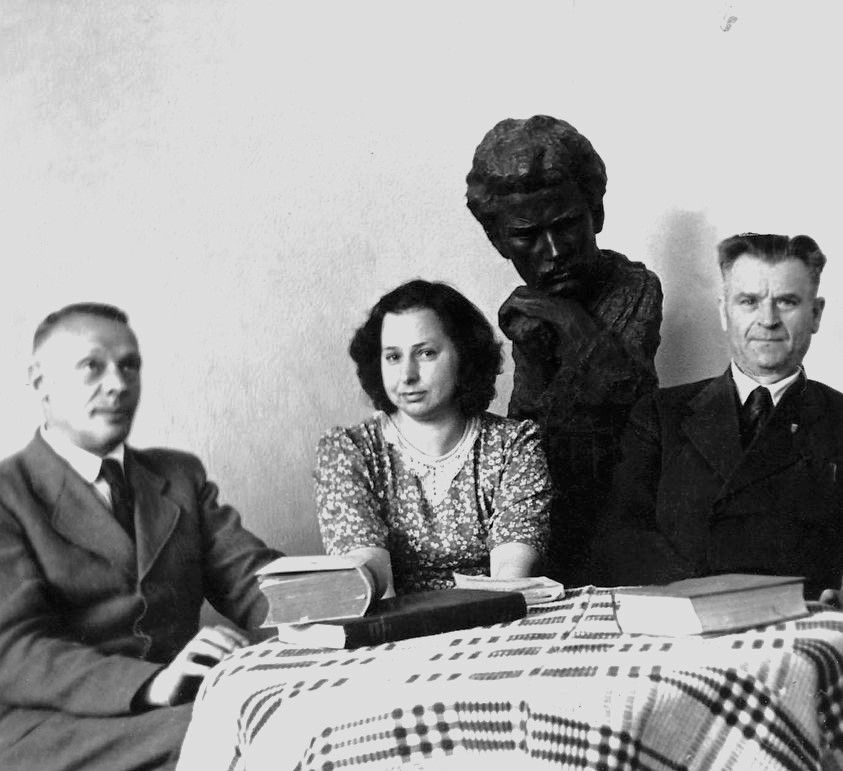
At the Belarusian Cultural Union.
Left to right: Mikalaj Kulikovich-Shchahlou, Natalla Arseńnieva, Viachasłaŭ Sieliach. Minsk, 1944.
To librettos by Arseńnieva he composed two operas: the lyrical-romantic Forest Lake and the historical Vsiaslau Charadziej, as well as an operetta, To the Warm Lands. With his music the Minsk Drama Theatre staged The Sunken Bell after Hauptmann’s play; another planned production, Kastuś Kalinoŭski by Mirovich, was banned by the German censors. He wrote the work Belarusian Musical Culture. He took part in the Second All-Belarusian Congress. During the Soviet advance he left Minsk together with M. Ravienski and emigrated to Germany, where he adopted the name Kulikovich. For a time he was held in a displaced persons camp.
1944–1950
Lived in Germany.
1946
Organised a touring Belarusian variety theatre that gave concerts across all of Western Germany. During this period he composed music for the Divine Liturgy.
1950
Moved to the United States. He first founded a Belarusian choir in New York, then settled in Chicago. He published critical articles and essays in publications of the Institute for the Study of the USSR (Munich) and the Belarusian Institute of Arts and Sciences (Chicago, USA).
1950s–1960s
He directed Belarusian choirs in Cleveland and Chicago. For 12 years he was choir director at the Greek Catholic Church of Christ the Saviour (Chicago). He performed in a theatre of musical miniature.
1953
In New York his book was published: Belarusian Music: A Short Outline of the History of Belarusian Musical Art.
1954, 1955, 1960 He published the Belarusian Songbooks.
1957 The work Belarusian Soviet Opera.
1961 The collection The Carollers.
1967 The collection Native Motifs.
Death of his daughter Natalla after a serious illness.
In Cleveland he edited and published several Belarusian dictionaries. The theme of the historical past of the Belarusian people lies at the heart of his operas.
He is the author of the operetta To the Warm Lands, symphonies, symphonic suites, cantatas, concertos, songs, and romances on poems by Janka Kupała (I Am Far From You, My Father’s Fields), M. Bahdanovich (Pahonia), and U. Dubouka (O Belarus, My Wild Rose). He composed unusually lyrical music for the songs Cornflowers, A Table Song, and Cornflowers (Vasilki) on his own texts. He also wrote music for theatre productions, sacred works, and arrangements of Belarusian folk songs.
His shellac records were popular not only in Belarusian emigration circles. Curiously, works from them were stolen and re-recorded in the USSR without crediting the author — as happened, for example, with the folk song O Eagle.
31 March 1969
Died in Chicago. Buried at St Adalbert’s Cemetery in Niles (a suburb of Chicago).
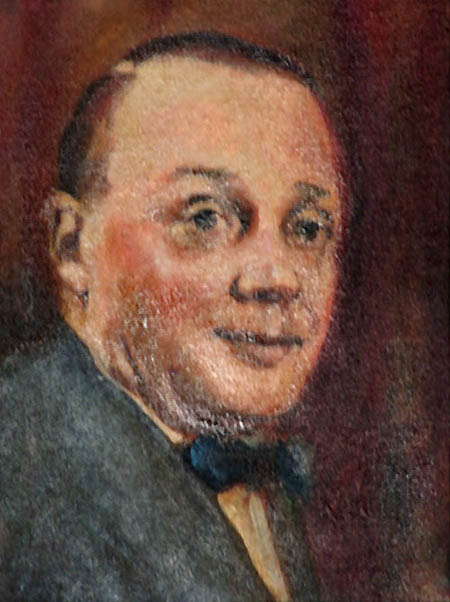
"Mikoła Kulikovich, composer". 1994.
Anatol Źmitravich Kryvienka. Fibreboard, oil. 40×30 cm.
Mikalaj Shchahlou-Kulikovich is regarded as one of the principal researchers and preservers of Belarusian musical culture in emigration, who succeeded in uniting the folk tradition with classical and church music.
His personal archive is held at the Francis Skaryna Belarusian Library in London.
Pieces by this composer
- Трапар Раства — Greek chant, Mikola Kulikovich ( PDF , MP3 )
- Херувікон №8 - Яблачынскі напеў — Mikola Kulikovich ( PDF , MP3 )
- Херувікон №6 - Слуцкі напеў (1649) — Mikola Kulikovich ( PDF , MP3 )
- Херувікон №4 - Беларускае — Mikola Kulikovich ( PDF , MP3 )
- Херувікон №3 — Mikola Kulikovich ( PDF , MP3 )
- Херувікон №2 — Mikola Kulikovich ( PDF , MP3 )
- Херувікон №1 — Mikola Kulikovich ( PDF , MP3 )
- Цябе апяваем — Mikola Kulikovich ( PDF , MP3 )
- Міласць міру №3 — Mikola Kulikovich ( PDF , MP3 )
- Усклікаў анёл да Ласкі Поўнай — Mikola Kulikovich ( PDF , MP3 )
- Сапраўды належыць — Mikola Kulikovich ( PDF , MP3 )
- Ойча наш №3 — Mikola Kulikovich ( PDF , MP3 )
- З намі Бог — Mikola Kulikovich ( PDF , MP3 )
- Цяпер адпушчаеш — Zhyrovichy chant, Mikola Kulikovich ( PDF )
- Хоць і заснуў Ты плоццю — Mikola Kulikovich ( PDF , MP3 )